
Introduction
Since ChatGPT was released to the public in late 2022, AI has moved from a niche technology topic to one of the biggest investment themes in global markets. Yet when most people think about AI, they still tend to focus on a handful of headline names: Nvidia, Alphabet, Microsoft, Amazon, Meta and OpenAI. That view is understandable, but it is incomplete.
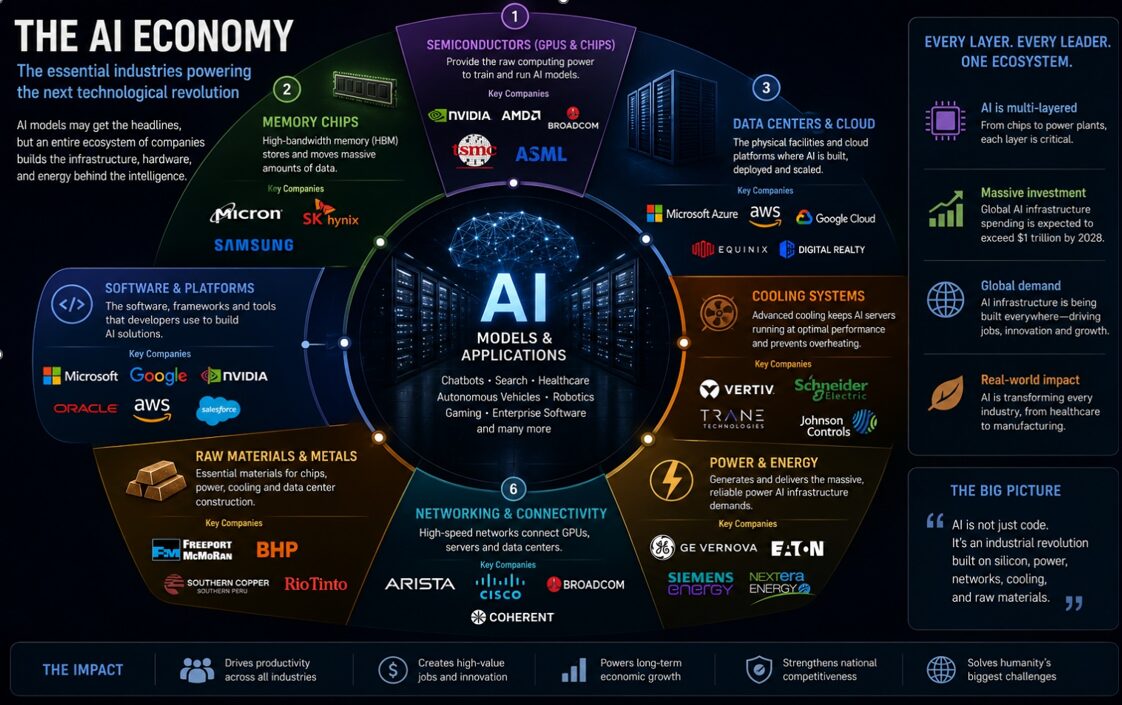
The real AI economy is much broader. Behind every chatbot, image generator, coding assistant and autonomous system sits a physical supply chain made up of semiconductor designers, memory manufacturers, foundries, equipment suppliers, data-centre owners, cooling specialists, power-grid companies, networking providers and commodity producers. Many of these businesses were not traditionally thought of as “AI companies”, yet their share prices have benefited materially from the AI cycle and may continue to benefit as infrastructure spending expands.
History has shown that technological revolutions create winners far beyond the companies making headlines. During the California Gold Rush, many fortunes were made not by miners, but by those selling picks, shovels, transport and supplies. AI appears to be following a similar pattern: the obvious winners matter, but the less obvious infrastructure providers may prove just as important.
Seven Winners from the AI Revolution
- Memory Chips
AI processors are only as effective as the memory supporting them. High Bandwidth Memory allows vast amounts of data to move quickly and efficiently between chips, making companies such as Micron, SK Hynix and Samsung critical suppliers to the AI economy. Memory has shifted from being viewed as a commodity to becoming one of the major bottlenecks in AI performance.2. Semiconductor Manufacturing
Designing advanced chips is difficult, but manufacturing them is even harder. TSMC remains central to the production of cutting-edge chips, while ASML, Applied Materials, Lam Research and KLA provide the specialised equipment required to manufacture them. Every new AI chip creates demand across this complex manufacturing supply chain.
- Data Centres
If AI chips are the brains, data centres are the factories. Microsoft, Amazon, Alphabet, Meta and Oracle are investing heavily in AI infrastructure, including servers, storage, networking, power and cooling. Companies such as Equinix and Digital Realty also benefit by providing the secure and connected facilities needed to support cloud computing and AI workloads.
- Cooling
AI servers generate enormous heat. As chips become more powerful, cooling has become essential to maintaining performance and protecting expensive hardware. Vertiv, Schneider Electric, Trane Technologies and Johnson Controls provide the cooling and thermal management systems required to keep AI data centres running efficiently.
- Power Infrastructure
Electricity may become one of the biggest constraints on AI growth. Hyperscale data centres can consume power on the scale of small cities, driving demand for transformers, switchgear, grid upgrades and power management systems. Eaton, Siemens Energy, ABB, Schneider Electric and GE Vernova are important beneficiaries of this trend.
- Copper
AI infrastructure requires significant copper for cables, transformers, cooling systems and electrical networks. Producers such as Freeport-McMoRan, BHP, Southern Copper and Rio Tinto are exposed to this demand, alongside broader growth from renewable energy, electric vehicles and infrastructure development.7. Networking
AI depends on moving enormous amounts of data between processors, storage systems and users. Arista Networks, Broadcom, Cisco and Coherent provide the switches, networking chips, optical components and fibre connectivity that allow large AI clusters to operate efficiently.
The Bigger Picture
AI is no longer just a software story. It is a global infrastructure build-out and one of the largest capital-expenditure cycles of our time. The world’s largest technology companies are investing heavily because the strategic cost of falling behind may be greater than the financial cost of overbuilding.
As we enter the second half of the year, we remain optimistic that AI can continue to support markets and deliver attractive long-term returns for investors. That said, after such a strong period of performance, some cooling-off or consolidation would not be surprising. The difficult question is when this may happen, and unfortunately, no one has a crystal ball.
Our focus remains on managing client capital with a long-term view, supported by sound fundamentals, disciplined portfolio construction and exposure to structural growth trends. We believe AI remains one of the most important investment themes of the next decade, but valuations, diversification and risk management remain essential. Not every AI-related company will benefit equally, and not every strong business is attractive at any price.
Should you have any questions about your portfolio or the themes discussed in this newsletter, please feel free to contact your advisor.
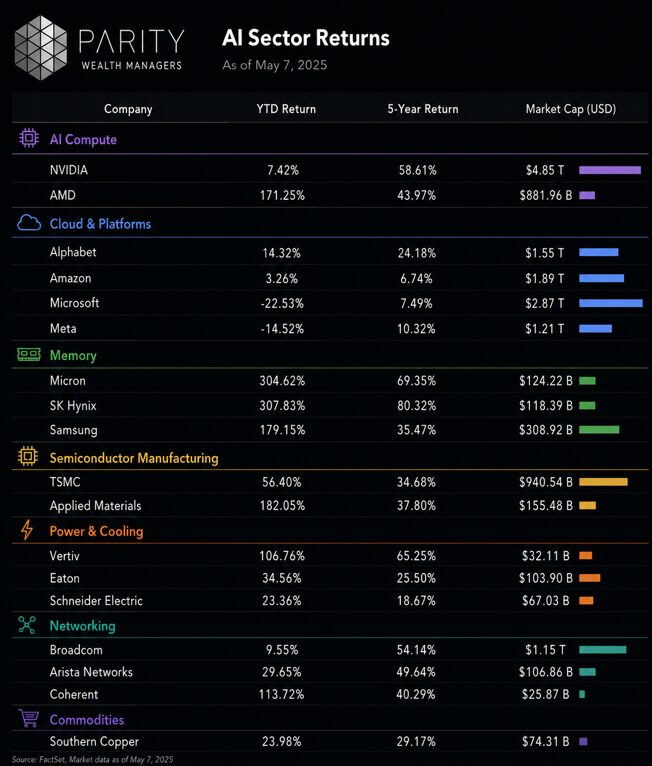
Share-Price Performance Across the AI Infrastructure Chain
The table below shows how the AI theme has spread well beyond the obvious software and semiconductor names.