
Introduction
Exchange-traded funds (ETFs) have redefined modern investing. Once considered niche instruments, they are now the preferred vehicle for both retail and institutional investors seeking low-cost, diversified, and tax-efficient exposure to global markets. In August 2025 alone, investors poured $119.3 billion into U.S.-listed ETFs, the largest monthly inflow of the year and a continuation of 2025’s record-breaking pace (FactSet, 2025).The scale is unprecedented. Year-to-date inflows of nearly $800 billion suggest that global ETF assets may soon surpass $20 trillion, doubling from levels seen only a few years ago. BlackRock’s iShares franchise, already commanding $5 trillion in global ETF assets, represents nearly 30% of this market. Vanguard follows at $3.9 trillion, underscoring the growing dominance of just a handful of providers (Reuters, 2025).
The Rise of the Giants
Scale and Concentration
The ETF market is increasingly concentrated among a few providers. iShares’ $5 trillion in assets places it firmly ahead of Vanguard at $3.9 trillion and State Street at $1.2 trillion. Together, the “Big Three” account for nearly 70% of the global ETF market. Their product suites now include funds of staggering scale:
- The iShares Core S&P 500 ETF (IVV) with $660 billion in assets.
- The Vanguard S&P 500 ETF (VOO), whose largest constituent, Nvidia, alone represents more than 8% of its weighting.
- The iShares Core MSCI EAFE ETF (IEFA) with $149 billion, offering exposure to developed markets outside the U.S. (Morningstar, 2025).
The Path to $10 Trillion
Industry forecasts suggest global ETF assets could nearly double within five years. If iShares maintains its current share, it could manage over $10 trillion in assets by the end of the decade (BlackRock, 2025). Such a milestone would represent a level of financial influence previously reserved for central banks.
2025 Winners
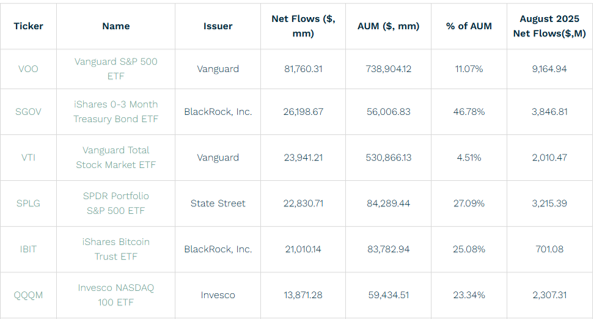
Source: ETF.com
- Passive Investing and Market Inelasticity
Rethinking the “Uninformed” Investor
For decades, economic theory treated passive investors as “uninformed noise traders,” their role in price discovery marginal at best. Crucially, the model assumed their share of the market was both small and commonly known.
Yet evidence shows otherwise. Recent studies place the true passive ownership share of the U.S. stock market at 35–40% in 2025, nearly double the previously assumed 16%. Passive demand is not only larger than expected but also inelastic. When an index constituent changes, passive investors must rebalance regardless of price.
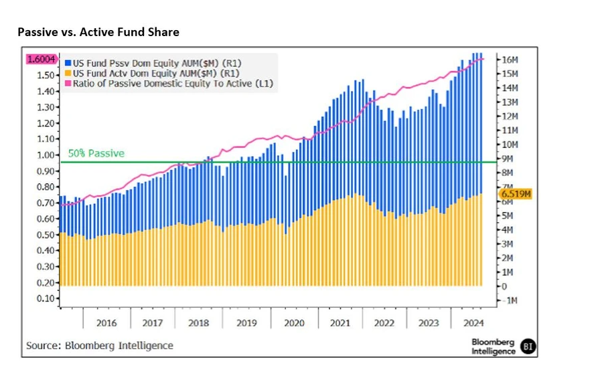
Source: ETF.com
- The ETF Explosion: From Utility to Excess
A Market of 4,600 Funds and Counting
Two decades ago, there were 450 ETFs. By 2025, there are more than 4,600, with nearly 700 launched this year alone (Morningstar, 2025). For the first time, the number of ETFs now exceeds the number of listed U.S. stocks. Choice has become both a benefit and a burden.
The Thematic Deluge
Since the SEC’s 2022 approval of single-stock ETFs, the market has seen an avalanche of thematic products. Investors can now access funds offering leveraged or inverse exposure to individual companies such as Tesla, Nvidia, or Meta. Some ETFs target themes as narrow as “AI pets” or ideological portfolios (“woke” versus “anti-woke”).
While this variety appeals to niche traders, it creates significant challenges:
- Investor Confusion: With multiple ETFs tracking nearly identical exposures, investors struggle to differentiate between meaningful innovation and gimmick.
- Survival Pressure: Issuers compete for shelf space, often resorting to high-fee, risky products to stand out.
- Failure Rates: Many ETFs fail to attract assets and are quietly liquidated within a few years.
As Douglas Boneparth observes, “choice is great until it becomes a burden.” The paradox of too much variety risks paralyzing rather than empowering investors.
The Origins of “Slop”
The first wave of risky ETFs included leveraged and inverse funds, often tied to highly volatile names like Tesla. These products promised amplified exposure but often delivered amplified losses. Since then, issuers have continued to churn out speculative products, prioritising speed to market and fee capture over investor outcomes.
Beyond Concentration Fears
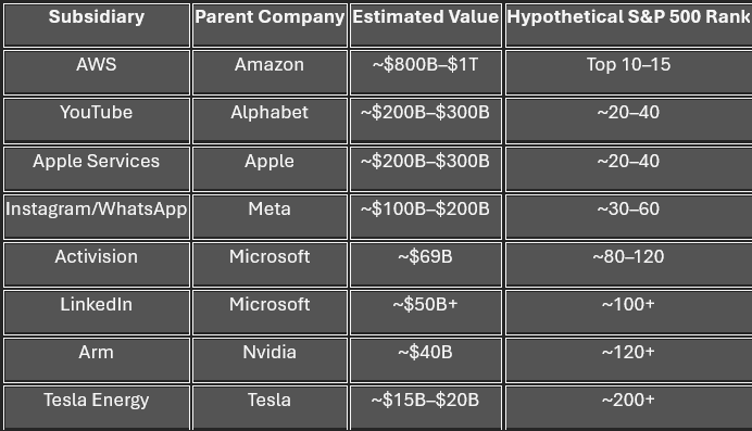
Concerns about the concentration of market gains among the so-called “Magnificent 7” (Apple, Microsoft, Amazon, Alphabet, Meta, Nvidia, and Tesla) are often overstated. Collectively, these firms have acquired more than 850 companies. Many of these subsidiaries—such as YouTube, Instagram, or AWS—would rank among the largest companies in the S&P 500 if spun off – read – https://www.moneyweb.co.za/financial-advisor-views/the-rise-of-the-magnificent-70/
Thematic Dominance
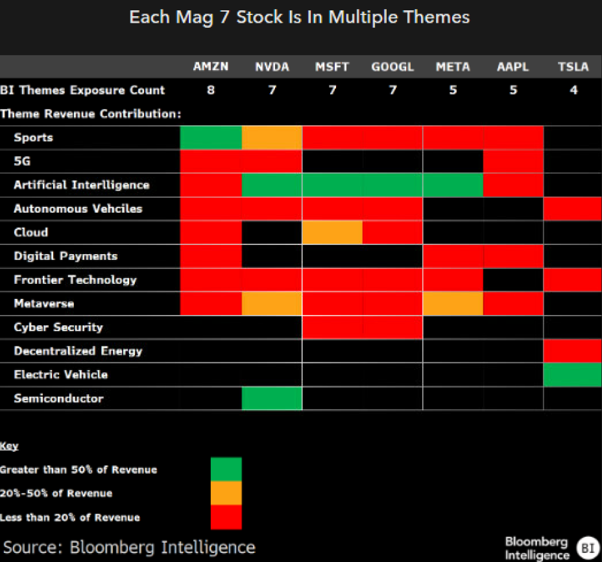
The Mag 7 also dominate thematic classifications. Amazon features in eight different investment themes, compared to an average of one for most S&P 500 constituents. This reflects their role at the frontier of innovation, spanning cloud computing, AI, e-commerce, and consumer devices.
Risks, Regulation, and the Future
Market Risks
The dominance of ETFs introduces systemic risks:
- Liquidity Mismatch: ETFs promise daily liquidity but often hold underlying assets with limited liquidity (Financial Times, 2020).
- Herding Behaviour: Mechanical flows can amplify market swings, as seen with Tesla’s inclusion.
- Concentration Risk: A small number of issuers and stocks dominate ETF allocations.
Regulatory Scrutiny
Policymakers are increasingly attentive. The growth of single-stock ETFs has raised concerns about investor protection, while the sheer dominance of the Big Three raises questions of market power and systemic risk.
The Road Ahead
The ETF juggernaut shows no sign of slowing. The twin drivers of low cost and active underperformance ensure continued inflows. Yet the industry must grapple with its own success: balancing innovation with responsibility, scale with resilience, and variety with clarity.
Looking forward:
Active ETFs are expected to grow tenfold in Europe, reaching $1 trillion by 2030 (Janus Henderson, 2025).
Tokenisation and Private Assets may represent the next frontier, allowing fractionalised ownership of real assets through ETF wrappers.
Industry Consolidation will continue as underperforming thematic products are closed or merged.
Greater Regulation is inevitable, particularly around liquidity stress-testing, disclosure, and systemic concentration.
Conclusion
The ETF revolution has fundamentally reshaped global financial markets. What began as a vehicle for efficient, low-cost market access has evolved into a nearly $17 trillion industry dominated by a handful of mega-issuers. Passive investing, once criticised as a simplistic and uninformed approach, has become a powerful force exerting increasingly inelastic demand on markets.
While we remain strong advocates of ETFs and passive investing, we do not believe investors should rely exclusively on one approach. Instead, we follow an active investment philosophy and believe there is significant value in combining passive and active strategies. In our balanced house-view portfolio, the Sierra Global Fund, we utilise a blend of both approaches to provide clients with broad market exposure through low-cost ETFs, while also incorporating high-conviction active positions that align with our long-term investment philosophy. This balanced approach seeks to capture the benefits of market efficiency without sacrificing selectivity and strategic allocation.
Ultimately, successful investing is not about choosing between active and passive management, but rather about understanding how each can complement the other to build resilient, diversified portfolios capable of navigating changing market conditions.
Listen to our podcast: The Rise of ETFs and the Risks of Passive Investing on Moneyweb: