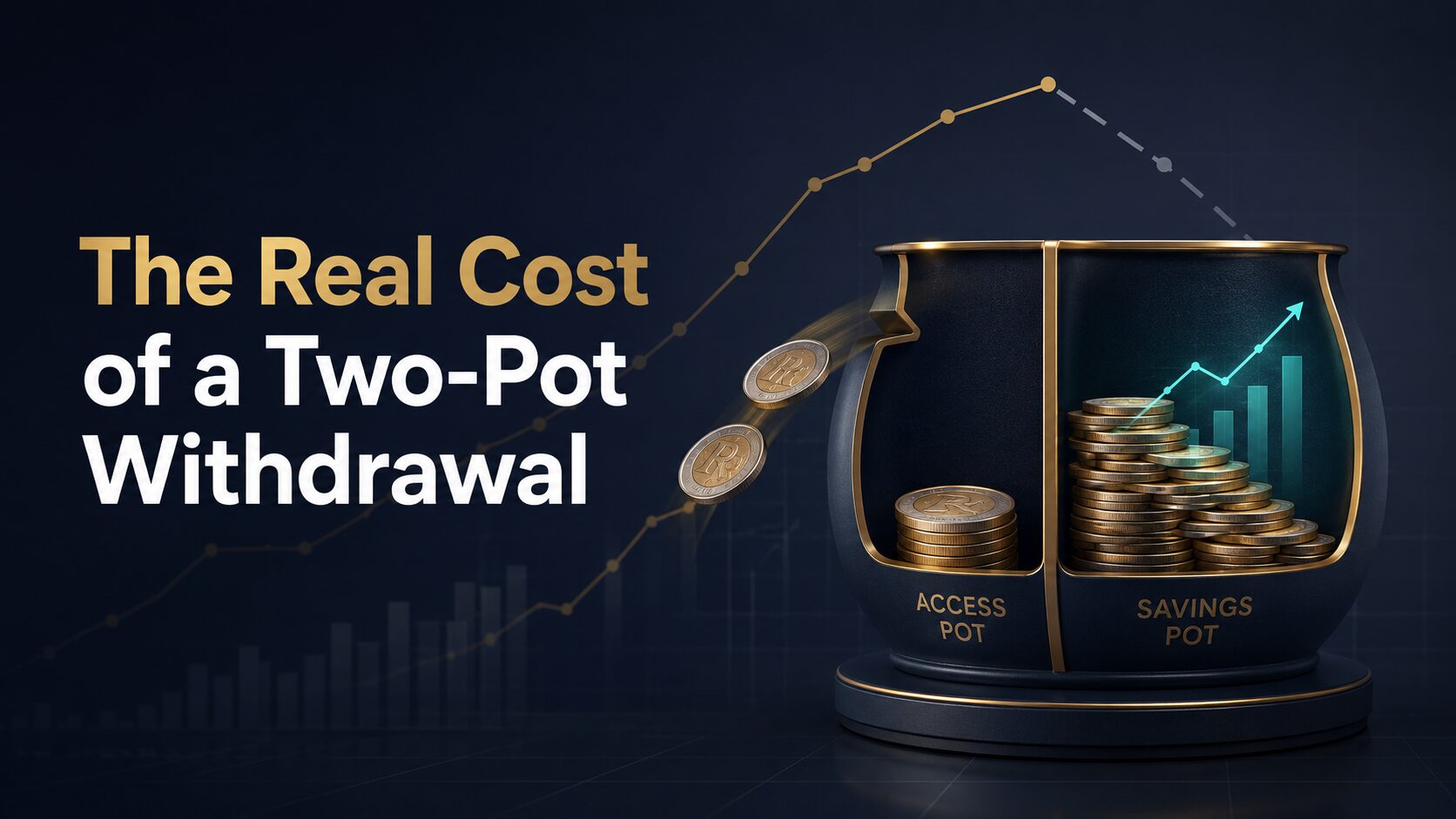

The Real Cost of a Two-Pot Withdrawal
South Africa’s two-pot retirement system is once again receiving attention following the start of the 2026/27 tax year on 1 March 2026. Retirement-fund members who made a withdrawal during the previous tax year may now be eligible to withdraw again, provided they have at least R2,000 available in their savings component.
For many investors, accessing a relatively small portion of their retirement fund is unlikely to be necessary. However, the two-pot system highlights a principle that applies at every level of wealth: capital intended for retirement should be protected, invested with purpose and accessed only as part of a considered financial plan.
How does the two-pot system work?
Introduced on 1 September 2024, the system was designed to balance two competing needs. It gives retirement-fund members limited access to their savings during genuine financial hardship, while preserving the majority of new retirement contributions for retirement.
Retirement savings are broadly divided into three components:
- The vested component contains most retirement savings accumulated before 1 September 2024 and generally remains subject to the previous retirement-fund rules.
- The savings component receives approximately one-third of new retirement-fund contributions and may be accessed before retirement, subject to the applicable rules.
- The retirement component receives approximately two-thirds of new contributions and generally has to remain invested until retirement.
A member may ordinarily make one withdrawal from the savings component during a tax year. The minimum withdrawal is R2,000, while the maximum is the available balance in the component.
Importantly, there is no requirement to withdraw the full amount—or to withdraw anything at all. Money left in the savings component remains invested and continues to grow. It does not expire at the end of the tax year.
Accessible does not mean tax-free
A savings-component withdrawal is added to the member’s taxable income and taxed at the applicable marginal income-tax rate. In the 2026/27 tax year, individual marginal rates range from 18% to 45%.
The retirement-fund administrator applies to SARS for a tax directive and deducts the required tax before paying the remaining amount to the member. Fund administration charges may also apply, while any outstanding tax debt owed to SARS could further reduce the amount received.
Consider someone who has R30,000 available and is taxed at an illustrative marginal rate of 36%. Approximately R10,800 may be deducted for tax, leaving around R19,200 before administration fees or any other deductions.
A taxpayer in the highest marginal tax bracket could receive even less. The amount displayed in the savings component is therefore a gross value, not necessarily the amount that will be deposited into the member’s bank account.
The greater cost is lost compounding
The immediate tax charge is only one part of the calculation. The more significant cost may be the future growth that is forfeited.
If R30,000 remained invested for 20 years and achieved an illustrative return of 8% per annum, it could grow to R140,000. A member may therefore receive less than R20,000 today while sacrificing substantially more retirement capital in the future.
This illustrates why repeated annual withdrawals can become particularly damaging. Each individual withdrawal may appear relatively modest, but collectively they interrupt the compounding process and reduce the capital ultimately available to provide an income during retirement.
The true cost of a withdrawal is consequently not simply the amount taken out. It is the withdrawn capital, the tax paid and the future investment returns that capital could have generated.
When could a withdrawal be justified?
Accessing the savings component may be reasonable where a member faces a genuine financial emergency and has exhausted other appropriate options. Examples may include:
- An urgent medical expense;
- A period of unemployment;
- Preventing the loss of a home;
- Meeting an unavoidable essential financial obligation; or
- Settling very expensive unsecured debt where doing so will permanently improve the member’s financial position.
Debt requires particular caution. Using retirement savings to settle a high-interest credit card may make financial sense, but only if the underlying cause of the debt is also addressed. If the credit card is simply used again, the member will be left with renewed debt and less retirement capital.
The lesson retirement planning
For wealthier investors, retirement planning extends well beyond the balance of a pension fund or retirement annuity. It involves coordinating retirement funds, discretionary investments, offshore assets, trusts, business interests, property, tax planning and estate-planning structures.
The objective is not merely to accumulate the largest possible portfolio. It is to ensure that the overall structure can reliably fund the investor’s desired lifestyle, withstand periods of market volatility, provide sufficient liquidity and ultimately transfer wealth efficiently to the next generation.
The two-pot system reinforces the value of separating capital according to its intended purpose:
- Short-term liquidity for emergencies and foreseeable expenditure;
- Medium-term capital for planned purchases and opportunities;
- Long-term retirement capital intended to fund future income; and
- Legacy capital intended for future generations or philanthropic objectives.
Maintaining adequate liquidity outside retirement funds reduces the likelihood that long-term investments will need to be sold or accessed at an inappropriate time.
Retirement planning should begin long before retirement
The 2026 Sanlam Benchmark research found that retirement-fund members only begin actively engaging with their retirement funds, on average, 3.4 years before they stop working. By that stage, there may be very little time to correct a meaningful capital shortfall.
A robust retirement strategy should be reviewed regularly and consider:
- The level of income required in retirement;
- The effect of inflation on future living costs;
- Healthcare and long-term care expenses;
- Expected longevity;
- The sustainability of retirement drawdowns;
- Tax-efficient use of retirement and discretionary investments;
- Appropriate local and global diversification;
- Beneficiary nominations and estate-planning arrangements; and
- The appropriate balance between accessible and long-term capital.
Retirement planning is ultimately an ongoing process rather than a decision made when employment ends. Starting early creates flexibility. Leaving it too late often forces difficult compromises involving spending, investment risk or the timing of retirement.
Five questions to ask before withdrawing
Before accessing a savings component, members should ask:
- Is this a genuine financial emergency or discretionary expenditure?
- What will I actually receive after tax and administration charges?
- Is there a less damaging way to fund the expense?
- Will the withdrawal permanently solve the problem?
- What could this money be worth by the time I retire?
Retirement money remains retirement money. Every withdrawal should be evaluated against its tax cost, its effect on future compounding and the investor’s broader financial plan.
Clients who would like to review their retirement position, liquidity reserves or broader long-term investment strategy are welcome to contact their Parity Wealth Manager.
To listen to our discussion – See below link
https://omny.fm/shows/early-breakfast-talk/finance-what-could-a-two-pot-withdrawal-cost-you