From Momentum to Quality: The Next Phase of the Technology Trade
For much of the past year, markets have rewarded momentum. Investors chased the strongest earnings revisions, the highest-beta stocks and almost anything linked to the next major growth theme. Artificial intelligence was the clearest example, with capital flowing into semiconductors, data centres, AI software and infrastructure businesses.
July, however, was a reminder that a compelling growth story does not automatically make a compelling investment. Several speculative AI infrastructure stocks sold off sharply as investors questioned the quality and sustainability of their growth. CoreWeave fell roughly 40% during the early-July sell-off despite revenue growth of more than 100%, while Nebius declined approximately 36% through mid-July. The concern was not AI demand itself, but whether valuations, competition and rising capital requirements could support attractive long-term returns.
The market’s message is becoming clearer: growth alone is no longer enough. Investors increasingly want companies that can grow profitably, protect margins, generate free cash flow and fund investment without weakening their balance sheets. That creates a different backdrop for technology, where quality may begin to matter more than momentum.
This is where the Magnificent Seven become particularly relevant. Microsoft, Alphabet, Amazon, Meta, Nvidia, Apple and Tesla have scale, global reach and powerful competitive advantages. Several also have the financial flexibility to keep investing heavily while still generating significant earnings and cash flow.
From momentum to fundamentals
Momentum can be powerful. When earnings expectations are rising, capital tends to flow towards companies showing the fastest growth, creating a cycle of higher expectations, rising share prices and further inflows.
That dynamic was evident during the AI investment cycle. Businesses linked to AI infrastructure were rewarded heavily, sometimes before investors had a clear view of how those companies would convert spending into sustainable returns.
As the cycle matures, however, markets tend to become more selective.
Morgan Stanley Chief Investment Officer Mike Wilson recently argued that the US economy and equity market are moving from an early-cycle environment towards a mid-cycle phase. Earlier in the cycle, lower-quality, higher-beta companies and dramatic earnings-revision stories performed strongly. As conditions mature, investors tend to focus more on sustainable earnings, margins and free cash flow.
The distinction matters. Investors may still want growth, but they increasingly want growth that can be measured in profits and cash flow rather than only revenue forecasts and future potential. That could become one of the defining themes of the next stage of the market.
Quality, scale and financial flexibility
Quality is a broad investment concept. Traditionally, investors have looked for strong balance sheets, high returns on capital, recurring revenues, pricing power, stable margins and durable competitive advantages. Technology now contains businesses that combine many of these characteristics with structural growth.
The Magnificent Seven are relevant not simply because they are large, or because they are associated with AI, but because scale changes the economics of growth. Microsoft, Alphabet, Amazon and Meta can invest billions in infrastructure, cloud, advertising technology and artificial intelligence while their existing businesses continue to generate substantial cash flow.
A smaller technology company may need external capital simply to build the infrastructure required to compete. By contrast, the largest platforms can fund investment from businesses that are already profitable at scale. That financial flexibility allows them to invest through the cycle, adjust spending when necessary and continue innovating without relying on favourable market conditions to survive.
The Magnificent Seven are not one trade
The “Magnificent Seven” label can make these companies appear like a single investment. They are not.
Microsoft is driven by enterprise software, cloud infrastructure and productivity applications. Alphabet combines Search, advertising, YouTube and Google Cloud. Amazon spans e-commerce, cloud computing and advertising. Meta remains primarily a global advertising platform. Nvidia supplies the computing infrastructure behind AI, Apple has built one of the world’s most valuable consumer ecosystems, and Tesla remains largely an automotive business with optionality from autonomy and robotics.
AI is important to several of these businesses, but it is not the entire investment case. That matters because investors do not necessarily need AI valuations to keep expanding for these companies to create value.
The valuation premium has compressed
Valuation is the most interesting part of the current setup.
At the end of 2023, the Magnificent Seven traded at approximately 29.6 times forward earnings, compared with around 20.9 times for the S&P 500. By August 2025, the group’s forward P/E had risen to roughly 36 times, compared with approximately 22 times for the broader market.
Today, the picture is different. BlackRock’s latest assessment puts the group’s forward P/E at approximately 25.8 times, down from 34.1 times at the end of 2025, despite continued earnings growth. Investors are therefore paying far less for each dollar of earnings than they were only months ago.
That does not make the shares cheap in absolute terms, but it does make the risk-reward more balanced. If earnings continue to grow while valuation multiples stabilise, investors may benefit from earnings growth rather than relying solely on further multiple expansion. The conversation has shifted from paying almost any price for AI exposure to assessing whether durable earnings growth can justify the premium.
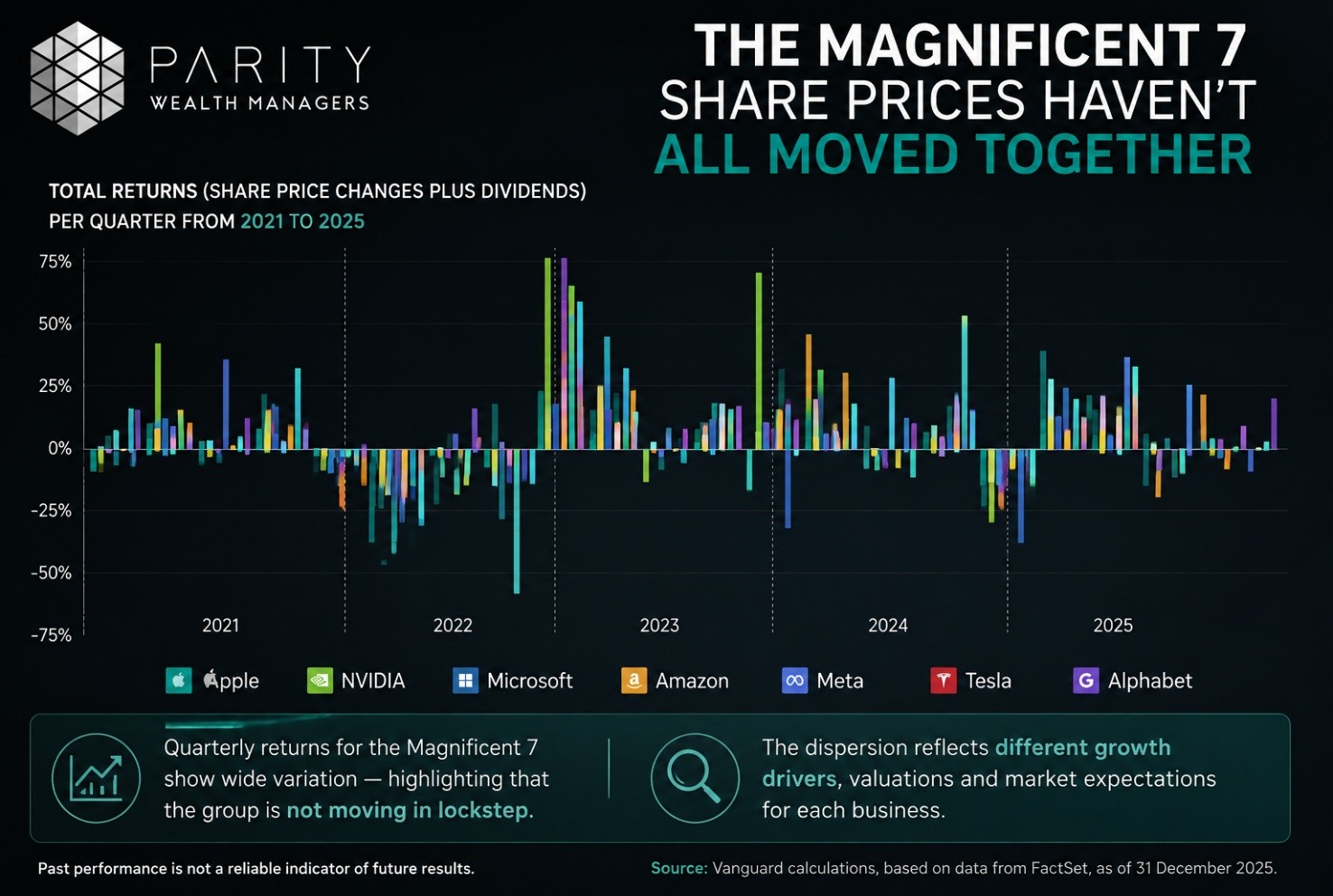
The Magnificent 7 is no longer moving together
Although the Magnificent Seven are often discussed as a group, their share prices have not behaved like a single investment. Performance has become more dispersed as investors differentiate between business models, earnings quality, capital intensity and valuation.
Why scale still matters
Scale may become one of the most important advantages in the next stage of the technology cycle. Microsoft can invest heavily in cloud infrastructure while its software business produces substantial cash flow. Amazon can fund AWS and logistics investment while advertising grows. Alphabet can invest in cloud and AI while Search and YouTube remain highly cash generative. Meta can raise infrastructure spending while its advertising platform continues to support profitability.
This ability to absorb the cost of growth is a major advantage. It does not mean these companies are risk-free, or that every investment will earn an attractive return. It means they have the financial resources, customer bases and competitive positions to adapt if the market environment becomes more demanding.
Conclusion
The market appears to be entering a more selective phase of the technology cycle. AI and high-growth stocks are unlikely to lose their importance, but July showed that investors are becoming less willing to reward revenue growth without evidence of sustainable economics behind it.
That shift could favour the highest-quality members of the Magnificent Seven. Companies such as Microsoft, Alphabet, Amazon, Meta and Nvidia combine scale, established revenue streams, strong competitive advantages and the financial flexibility to invest heavily while continuing to generate substantial cash flow.
The compression in valuation multiples also changes the backdrop. Investors are no longer paying the same extreme premiums seen during the peak of technology and AI enthusiasm, while earnings have continued to grow.
The opportunity may therefore be shifting from owning momentum to owning quality growth. If that rotation continues, the Magnificent Seven could benefit not because they are the market’s favourite stocks, but because several have become durable technology platforms capable of compounding earnings over the long term.