How Does a U.S. Government Shutdown Impact Markets?
On Wednesday, the U.S. federal government officially entered a shutdown after Congressional Democrats and Republicans failed to agree on a funding package. Government shutdowns occur when Congress does not pass, or the President does not sign, the necessary appropriations bills or continuing resolutions for the new fiscal year, which begins October 1. Unlike a default, a shutdown primarily affects non-essential federal employees, who are furloughed or work without pay until funding is restored. While politically disruptive and widely reported, shutdowns are generally short-lived and historically have had limited economic impact. The current deadlock, largely cantered around disagreements over healthcare subsidies, underscores the persistent challenges in balancing federal budgets while maintaining government operations.
Since 1950, the United States has experienced 21 government shutdowns, most lasting only a few days. Despite the attention they receive, these events rarely derail financial markets, highlighting the resilience of equities and other asset classes. However, shutdowns are not without consequences; they can affect the labour market, consumer confidence, and the release of key economic data. Understanding both the historical performance of markets during shutdowns and the broader economic implications is critical for investors navigating the current environment.
Market Impact of Government Shutdowns
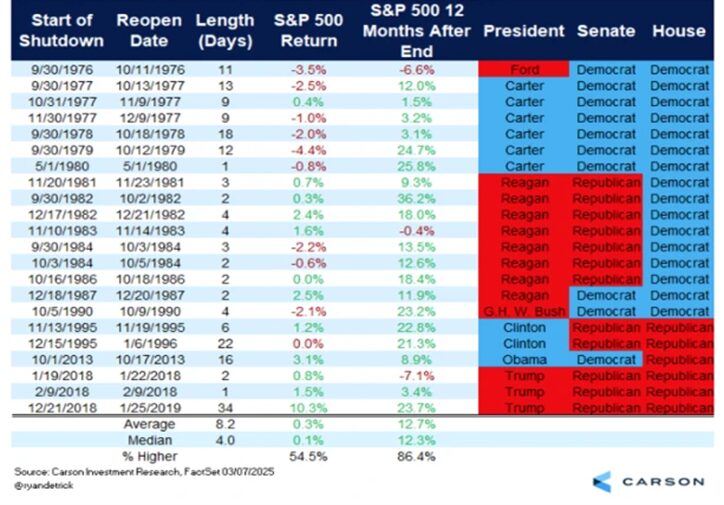
Historically, government shutdowns have had a limited effect on the U.S. stock market. The S&P 500 offers a clear lens through which to evaluate investor reactions. Over the 20 shutdowns since 1976, the S&P 500 has averaged a gain of 0.05% (USD) during the shutdown period itself. In other words, shutdown events have had virtually no statistical significance in driving market performance. More often, broader economic news and corporate earnings have exerted a stronger influence on stock prices than the mere fact of a shutdown.
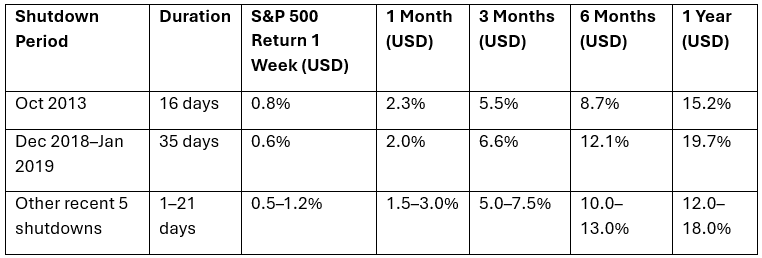
The most recent and longest shutdown in modern history occurred between December 22, 2018, and January 25, 2019. Lasting 35 days, it was widely expected to weigh on markets. Government contractors faced delayed payments, federal agencies slowed operations, and thousands of federal workers were furloughed. Yet, during this period, the S&P 500 gained more than 10% (USD), reflecting a rebound from earlier volatility in the fourth quarter of 2018. Analysts attributed this rise to positive developments in U.S.-China trade relations and declining interest rates.
Other shutdowns also demonstrate market resilience. For example, the 16-day 2013 shutdown led to an S&P 500 increase of more than 3.00% (USD). In fact, the last five shutdowns prior to 2025 all saw the S&P 500 rise, despite varying durations and political contexts. These examples illustrate that while shutdowns generate headlines, investors tend to focus on long-term corporate earnings and broader economic fundamentals rather than short-term government gridlock.
Economic Considerations and Labor Market Implications
Although markets often weather shutdowns with little impact, the economic implications can be more pronounced, particularly if shutdowns are extended. The current U.S. economy has experienced significant volatility in 2025. First-quarter GDP declined, consumer sentiment fell early in the year, and the labour market has shown signs of weakening. Extended furloughs could exacerbate these challenges, particularly in the Washington, D.C., area, where federal employment is a major economic driver. Reduced pay checks can dampen consumer spending, affecting sectors beyond government contractors, including retail, services, and hospitality.
Conclusion
While government shutdowns capture headlines and create temporary uncertainty, the historical record shows that they rarely derail financial markets in a significant way. The S&P 500 has generally posted gains during shutdown periods, with one-year post-shutdown returns averaging 12.7% (USD). Volatility may increase in sectors directly affected by federal spending, and delayed economic reporting can add short-term uncertainty.
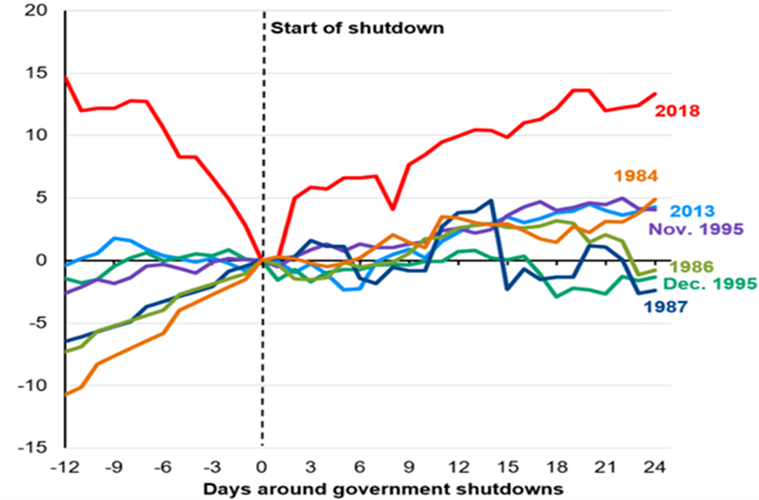
Source: FactSet, Standard & Poor’s and J.P. Morgan Asset Management, 2025. S&P 500 returns around past government shutdowns.
Ultimately, the impact of a shutdown depends less on the political event itself and more on the overall health of the economy, corporate balance sheets, and external factors such as trade relations and monetary policy. Investors who maintain a long-term perspective and consider these broader influences are more likely to view a shutdown as a temporary interruption rather than a threat to market stability. As history demonstrates, shutdowns are often brief and, while inconvenient for federal employees, are unlikely to alter the trajectory of U.S. equities significantly
In summary, government shutdowns are a reminder of political divisions, but they are not a predictor of market performance. Economic fundamentals, corporate earnings, and broader market conditions remain the true drivers of stock returns. Investors should monitor developments but avoid reactionary decisions based solely on temporary political events, using shutdown periods instead as an opportunity to assess long-term portfolio strategy.