Understanding the Divergence in Short- and Long-Term Interest Rates: Insights from the US and South Africa
On Wednesday, 17 September 2025, the US Federal Reserve cut its benchmark interest rate by 25 basis points, lowering the federal funds rate to a range of 4.00% to 4.25%. This marks the Fed’s first rate cut since December 2024, prompted by unexpectedly weak labour data despite persistently elevated inflation. After holding rates steady through the first five meetings of 2025, the Fed’s shift signals growing concern over economic softness.
In contrast, the South African Reserve Bank (SARB) left its policy rate unchanged at 7.00%. Since September 2024, SARB has eased rates by a cumulative 125 basis points, following earlier tightening to contain inflationary pressure.
Why Short- and Long-Term Rates Move Differently
While central banks like the Fed and SARB directly set short-term rates, such as the overnight repo or federal funds rate, long-term interest rates (e.g. 10- and 30-year bonds) are determined by the market. These longer maturities reflect investors’ expectations for a range of macroeconomic variables, including:
- Inflation expectations: Investors demand higher yields if they expect future inflation to erode purchasing power.
- Economic growth forecasts: Stronger expected growth generally supports higher long-term yields.
- Supply and demand dynamics: Rising government debt issuance or declining foreign demand can push yields up.
- Risk and uncertainty premiums: The more uncertain the future, the higher the compensation investors seek.
This dynamic explains why the Fed may cut short-term rates to stimulate demand, while long-term yields remain elevated or even rise if inflation fears or fiscal concerns persist.
Decoding the Yield Curve
The yield curve illustrates the relationship between bond maturities and their respective yields. Under normal conditions, long-term rates exceed short-term rates, reflecting the time value of money and compensation for risk over longer periods.
However, when the curve inverts, short-term rates often exceeding long-term ones can signal deteriorating economic sentiment or a looming recession.
Current Yield Curve Snapshot (18 September 2025)
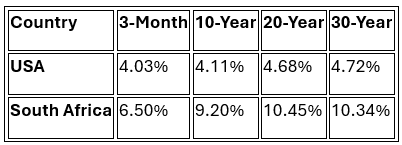
In the US, long-term yields have risen sharply in recent months, reflecting a broad sell-off in Treasuries as markets reassess the trajectory of inflation and fiscal sustainability. While the Fed has pivoted toward rate cuts, the bond market remains wary. In South Africa, the steepness of the curve reflects both the inflation premium and the structural inefficiencies in the local bond market.
Mortgage Rates: Not Always Tied to Policy Rates
In the United States, mortgage rates are not directly linked to the Fed’s short-term rate. Instead, they track long-term yields, particularly the 10-year Treasury, due to the long-dated nature of most home loans and the role of mortgage-backed securities (MBS). As a result:
- A Fed rate cut may not necessarily lower mortgage rates.
- Mortgage pricing reflects broader bond market conditions, credit risk, and investor appetite.
A declining 10-year yield, driven by improved inflation expectations or reduced fiscal pressure, would be more beneficial to homeowners than a lower federal funds rate alone.
The South African Context: A More Direct Transmission
South Africa’s mortgage and credit markets operate differently. Commercial banks typically set their prime lending rate as the repo rate plus 3.50%, currently placing the prime rate at 10.50%. When SARB adjusts the repo rate, banks quickly pass on the change to consumers via:
- Mortgage rates (usually prime ± a margin)
- Credit card and personal loan interest
- Fixed deposits and savings products
This direct transmission mechanism is influenced by:
- Bank funding models: SA banks rely heavily on short-term wholesale funding, making repo rate changes impactful.
- Market structure: A shallower bond market limits the development of long-term, market-driven rates.
- Regulatory frameworks: Prudential rules reinforce the link between SARB’s monetary policy and commercial lending.
- Currency and inflation volatility: As an emerging market, South Africa requires faster policy transmission to manage inflation and currency stability.
In essence, South African households and businesses experience more immediate effects when SARB adjusts policy, unlike their US counterparts.
Final Thoughts: Policy, Perception, and Positioning
At Parity Wealth Managers, we are closely monitoring global macroeconomic shifts and central bank trajectories. As we enter the final quarter of 2025, we remain cautiously optimistic. Robust corporate earnings in the US continue to surprise on the upside, and historically, rate-cutting cycles tend to support equity valuations.
Still, with rising geopolitical uncertainty and diverging policy paths, staying disciplined, globally diversified, and data-driven will be key.