On 21 October, Finance Minister Enoch Godongwana gave his mini-budget speech in Cape Town, Parliament.
In short: South Africa’s finances are in better shape, but the economy is still growing too slowly.
Take note: The Medium-Term Budget Policy Statement (MTBPS) is relevant until the February 2027 Main Budget Speech
GROWTH
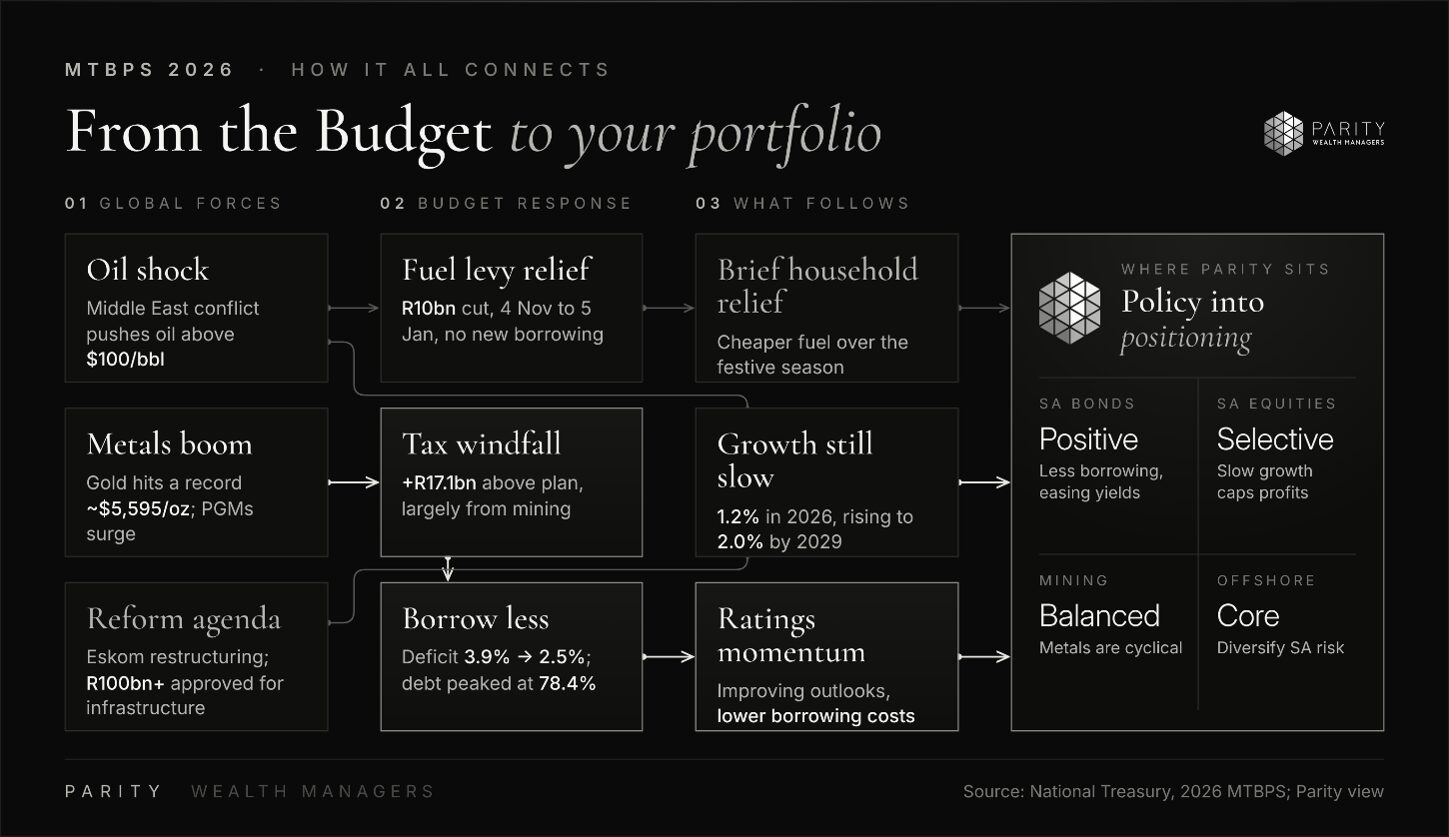
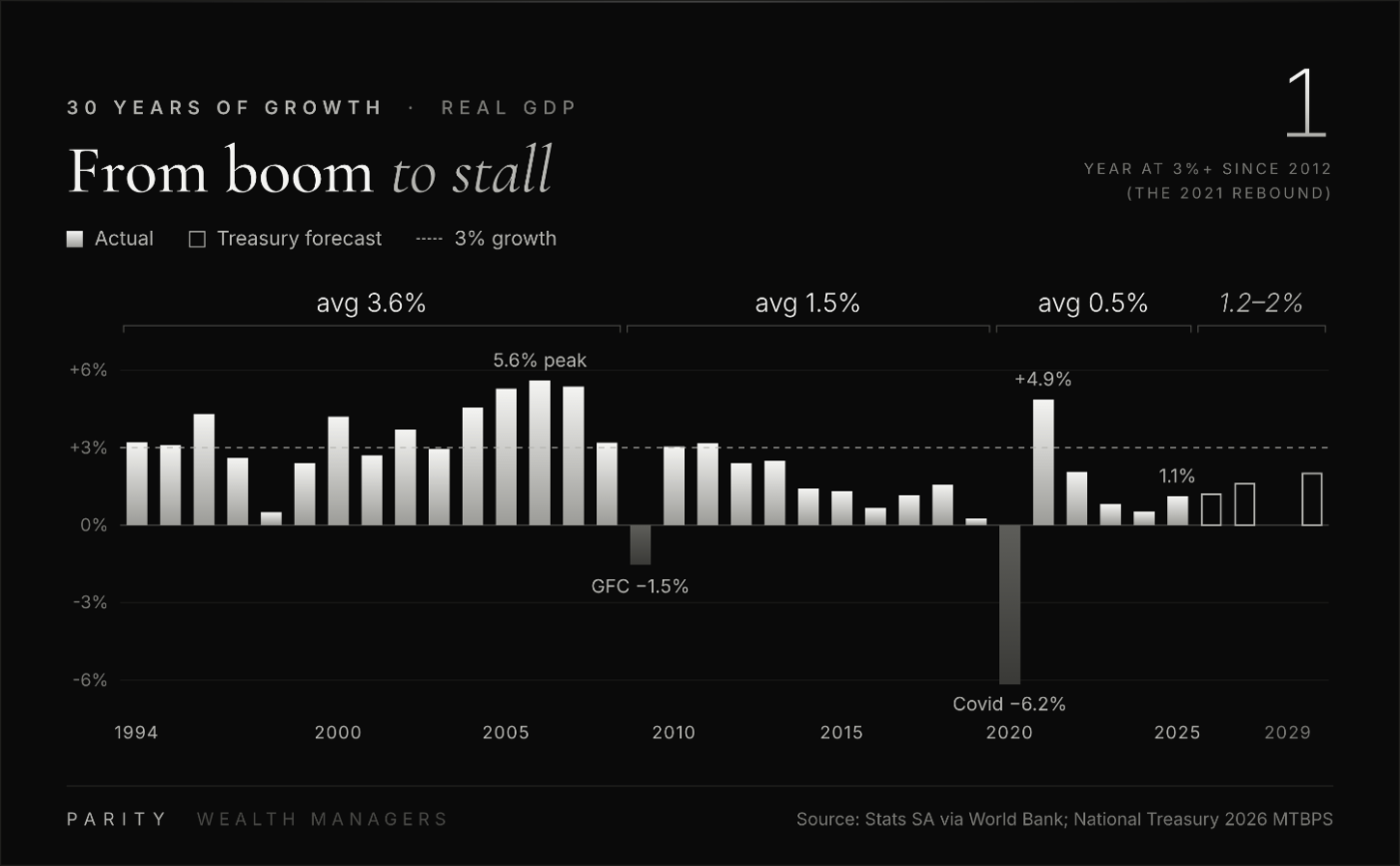
The 2026 growth forecast was cut to 1.2% from 1.6% in February. High oil prices from the Middle East conflict have played a role in this decline. Growth is expected to reach 1.6% in 2027 and 2% by 2029
What this means: Government’s finances are becoming more stable, but the economy is still not growing fast enough. Faster growth is what creates jobs and lifts company profits. The government needs to aim for 5-8% growth (this is what Trevor Manuel, the previous finance minister from 1996 to 2009, targeted)
With population growth being larger than economic growth, we are not experiencing real economic growth. We should be aiming for nothing less than 3% for true impact.
DEBT AND DEFICIT
For the first time in nearly two decades, debt-to-GDP has stabilised at 78.4% in 2025/26, and is now falling. The budget deficit (the yearly shortfall between what government earns and spends) is 3.9%, slightly better than expected and expected to be 2.5% by 2030
The primary surplus is projected to rise from 1.7% of GDP this year to nearly 3% by 2030, which should help reduce borrowing and contain debt-service costs
What this means: Government is borrowing less. Less borrowing means less money lost to interest, and more confidence from investors in the economy.
REVENUE AND TAXES
Government collected R17.1 billion more in tax than expected.
Much of the extra money came from mining. Gold and platinum-group metal prices (platinum and palladium) jumped to high levels. Gold reached a record of approximately US$5,595 an ounce in January 2026. Mining companies made bigger profits, resulting in more tax, which allowed for more government revenue. Therefore, a large portion of the increased revenue is due to these mining companies. This is not the direct consequence of government amending policy measures. The Minister, in fact, warned that this extra income would not last.
What this means: The government benefited from certain high metal prices. The positive news is that the extra revenue will mostly be used to reduce borrowing rather than spending.
FUEL RELIEF AND EMERGENCY FUND
The fuel levy (a tax inside the petrol price) will be cut by R1.50 a litre on petrol and R3 on diesel from 4 November to 1 December. It then continues at a lower rate until 5 January 2027: R1.50 per litre off diesel and R1 off petrol. Minister Godongwana estimated the fiscal cost at R10 billion in forgone revenue. This expenditure is funded by reversing an earlier R10 billion transfer to the Central Energy Fund and therefore not new borrowing. A R10 billion emergency fund is also to be established for drought relief (El Niño) and possible further price spikes in energy.
What this means: Cheaper fuel over the festive season puts a little more money in your pocket. Although there is some relief for the new year, prices may rise again in January.

OVERALL SPENDING
Thanks to the extra tax revenue, the government can spend R45.5 billion more this year. It has also found about R50 billion in savings, including R13 billion by cutting social grant fraud. Government expects expenditure to grow 3.6% a year, from R2.7 trillion to R3 trillion by 2029/30.
What this means: Government is spending more without raising taxes, and is focusing on cutting waste and building infrastructure which will benefit the economy.
ADJUSTMENTS TO THIS YEAR’S BUDGET (APPROPRIATION BILL)
The main indicators are the following:
- 2 billion for unexpected costs, mostly disaster relief.
- 9 billion rolled over: money departments did not spend last year that they can now use. It is not new money.
- 3 billion self-financed: spending paid for by departments’ own income, such as fees, not by taxpayers.
- R823 million for SANDF troops to support police against gang crime and illegal mining.
What this means: These are sensible, targeted top-ups rather than a spending spree. The R1.9 billion rolled over is important as the government has not spent all its revenue in the previous financial year, therefore rolled over.
POLICE VEHICLES AND FIGHTING CRIME
R810 million will buy new vehicles for the South African Police Service. A further R2.2 billion goes to strengthening the courts, and R3.8 billion to hiring over 3,500 social workers to fight gender-based violence.
What this means: Government is showing it is serious about making the country safe. A safer country, with a functioning court system, provides for a safer and more stable environment.
INFRASTRUCTURE
R20 billion is set aside for new infrastructure projects. The total approved support has passed the R100 billion mark. Government is also partnering with the private sector to build infrastructure faster, and continuing to reform Eskom.
What this means: Better roads, electricity and water help businesses grow. This is important for long-term growth, but it depends on projects actually being delivered. Private sector intervention will aid the overall efficiency of government.
PROVINCES AND MUNICIPALITIES
Municipalities get an extra R21.8 billion to cover the rising cost of free basic services, whilst metros receive R13.4 billion more from the fuel levy. Provinces receive R20.5 billion more for health and education. These allocations are made just before the local government elections on 4 November.
What this means: More money for local services, together with stricter rules on how it is used, should help keep towns and cities stable and functioning on a higher level in providing services.
CREDIT RATINGS AND REACTION
All three major credit rating agencies (S&P, Fitch and Moody’s) are more positive about South Africa’s prospects. Business leaders called this a good mini-budget, and South Africa now borrows at rates close to some investment-grade countries.
What this means: A better credit rating is similar to a better credit score. It lowers the cost of borrowing for government and companies, and attracts foreign investors, which will ultimately benefit the South African economy and its landscape.
WHAT IT MEANS FOR YOUR INVESTMENTS
- Bonds and income funds: should benefit as the government borrows less and interest rates on its debt ease.
- South African shares: a more stable country supports local companies, but slow growth limits how fast profits rise.
- Mining shares: have done very well, but metal prices fluctuate. We prefer a balanced holding rather than chasing recent gains.
- Offshore investments: still important. Spreading money across various countries protects you if South African growth disappoints.
OVERALL OUTCOME AND WHAT WE EXPECT
Overall outcome: This can be considered a mini-budget with potentially good benefits and consequences. Government’s finances are healthier, debt is falling, and taxes are not rising. Part of this emanates from higher metal prices rather than a stronger economy. But the government intends to save most of its windfall revenue. The main weakness is still slow growth.
What we expect until February 2027:
- More credit rating upgrades are likely, which would lower borrowing costs.
- The extra mining tax will reduce as metal prices drop.
- Growth will improve only slowly unless required structural reforms speed up.
- Fuel prices could rise again after the relief ends early in 2027.
- We remain positive on South African bonds, selective on local shares, and committed to keeping money diversified offshore.