Global overview
The third quarter delivered a reminder that the biggest surprises do not always come from the riskiest assets. For most of July and August, markets enjoyed a steady summer, supported by strong
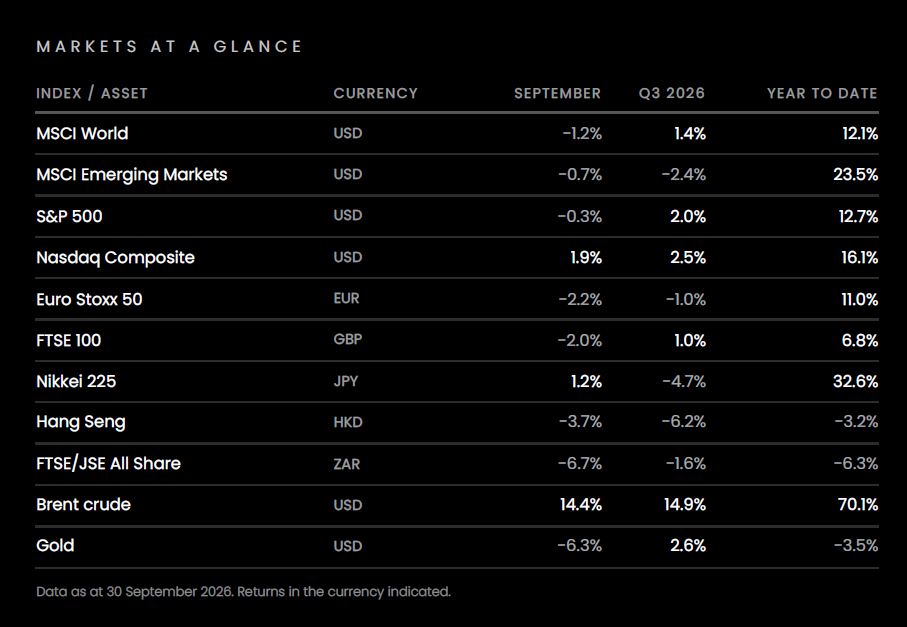
company earnings and continued enthusiasm for artificial intelligence. In September, the bond market took centre stage. The MSCI World Index fell 1.2% (USD) during the month but still gained 1.4% (USD) for the quarter, leaving it up 12.1% (USD) year to date. Emerging markets held up better, with the MSCI Emerging Markets Index slipping just 0.7% (USD) in September and remaining up 23.5% (USD) for the year.
The defining event of the quarter was the sell-off in US government bonds, traditionally the stabilising anchor in diversified portfolios. The US 10-year Treasury yield rose 54 basis points in September to 5.29%, its largest monthly rise in four years and its highest level since before the 2008 global financial crisis. Yields in Japan, Germany, France and the UK followed to multi-year highs. Three forces drove the move: an oil price back above USD 100 per barrel, a synchronised round of central bank rate hikes, and heavy borrowing by governments and AI-related companies.
Oil was the spark. The unresolved seven-month conflict between the US and Iran, together with temporary damage to Saudi Arabia’s East-West pipeline, pushed Brent crude up 14.4% (USD) in September and 14.9% (USD) over the quarter to around USD 103 per barrel, leaving it up 70.1% (USD) for the year. The US Dollar Index rose 2.0% in September as yields climbed. Gold, which pays no income, struggled once bonds began offering 5%: it fell 6.3% (USD) during the month, though a strong July and August left it 2.6% (USD) higher for the quarter.
Encouragingly, the shift in the sources of global returns, shown below, suggests markets are being driven by fundamentals rather than optimism. In 2025, equity returns came largely from rising valuations and, for offshore markets, a weaker dollar. In 2026, the picture has reversed. Earnings growth is doing all the work, while valuation multiples have contracted across every major region as higher yields make investors less willing to pay up for shares.
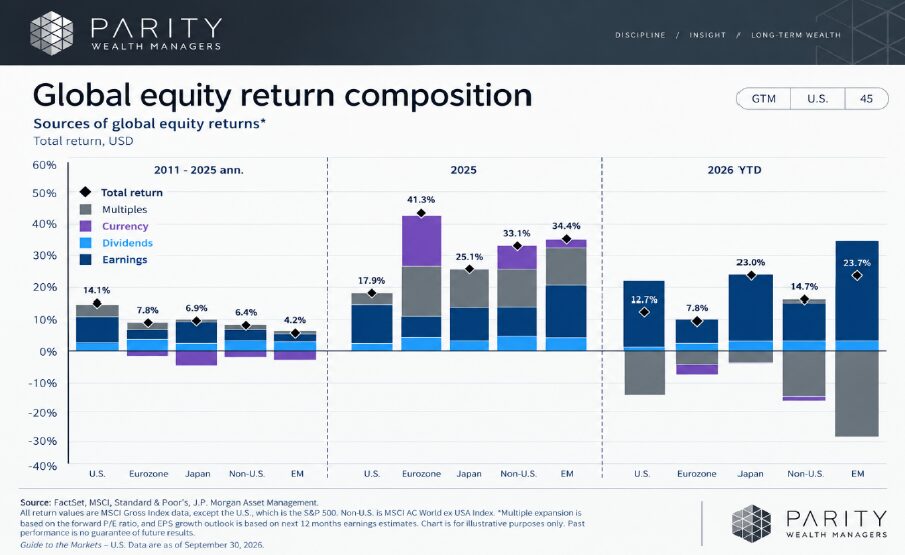
FIGURE 1 Global equity return composition: sources of global equity returns, total return in USD. Source: FactSet, MSCI, Standard & Poor’s, J.P. Morgan Asset Management.
Emerging markets illustrate this most clearly, with earnings growth of more than 50% partly offset by a roughly 35% fall in multiples, leaving a 23.7% (USD) return. The US (12.7%, USD) shows the same
pattern on a smaller scale, while Japan (23.0%, USD) has enjoyed the cleanest year. Returns built on profits rather than expanding valuations are, in our view, more durable, even if they feel less comfortable along the way.
United States
US equities ended the quarter in positive territory, but the headline numbers concealed a market that was narrowing beneath the surface. The S&P 500 slipped 0.3% (USD) in September but gained 2.0% (USD) over the quarter and ended within 2% of its 52-week high, leaving it up 12.7% (USD) year to date. The tech-heavy Nasdaq Composite rose 1.9% (USD) in September and 2.5% (USD) for the quarter, extending its year-to-date gain to 16.1% (USD).
Those headline gains were carried by a small group of AI beneficiaries. Chipmakers Intel (+34%), AMD (+30%), Marvell (+25%) and Micron (+11%) added almost a full percentage point to the S&P 500 in September alone, while Meta (+27%) enjoyed its best month since 2013 on rapid adoption of its Muse AI personal agent. Beyond this group, conditions were far tougher. The S&P 500 Equal Weight Index fell 4.8% (USD), the small-cap Russell 2000 declined 5.3% (USD), and 83% of S&P 500 companies now trade more than 10% below their 52-week highs. Only the Technology and Communication Services
sectors advanced, while Financials (-7.2%, USD) suffered most as major investment banks warned of subdued deal activity ahead of November’s midterm elections.
The Federal Reserve raised rates by 25 basis points to 3.75%-4.00%, its first increase since 2023. The economy gave it little reason to hesitate: payrolls rose by 162,000 in August, well ahead of expectations, and business activity reached its strongest level since 2021. Inflation remains the concern, with headline CPI at 3.4% and consumer confidence at its lowest since 2014. A softer-than expected core PCE reading of 3.0% at month end offered some relief, reducing the market-implied probability of an October hike to around 40%.
What keeps us constructive on US equities is the earnings picture. As the chart below shows, S&P 500 earnings per share are expected to grow 31.6% in 2026, more than four times the 2001-2025 average of 7.6%. Expanding profit margins account for 19.5 percentage points of that growth and revenue a further 13.2 points, reflecting AI-driven productivity gains and pricing power. Analysts expect earnings per share of USD 362 this year, rising to USD 417 in 2027 and USD 488 in 2028.
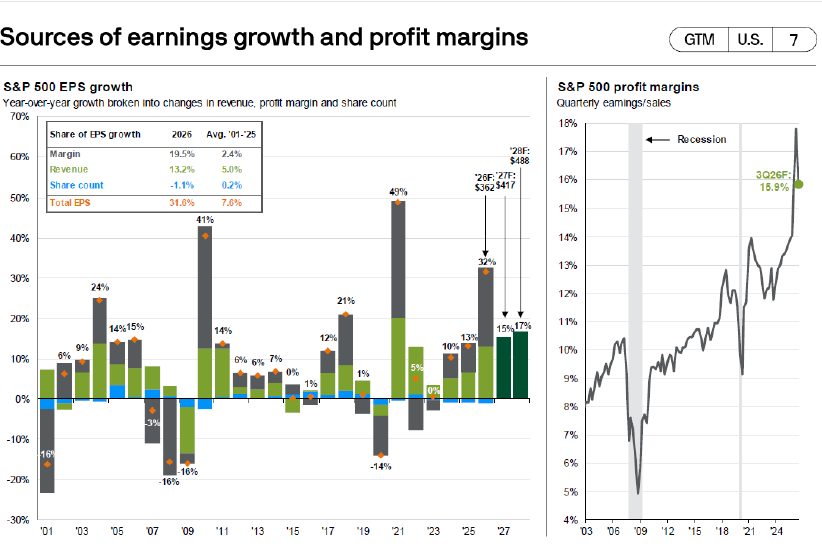
FIGURE 2 Sources of earnings growth and profit margins: S&P 500 EPS growth and quarterly profit margins. Source: J.P. Morgan Asset Management, Guide to the Markets.
The right-hand panel carries the one note of caution. Profit margins reached a record of close to 18% before easing to an estimated 15.9% for the third quarter as energy and input costs rose. Margins remain well above their long-term range, but the October reporting season will be important. If margins hold, earnings growth should be able to absorb higher bond yields; if they slip further, the market’s reliance on a handful of leaders becomes a vulnerability.
Europe
European equities gave ground in September, recording their first monthly decline in six months as higher energy costs and rising bond yields weighed on a region that imports most of its energy. The Euro Stoxx 50 fell 2.2% (EUR) during the month and 1.0% (EUR) over the quarter, though it remains up 11.0% (EUR) year to date. Performance varied sharply by country. Germany’s DAX fell 4.0% (EUR) in September but still edged 0.8% (EUR) higher for the quarter, while France’s CAC 40 declined 5.2% (EUR) over the quarter and is now down 2.3% (EUR) for the year amid fiscal and political uncertainty.
The European Central Bank raised rates early in the month and warned that energy prices could keep inflation elevated. Eurozone inflation rose to 3.2% in August from 2.9%, with energy prices 14.3% higher than a year ago. Encouragingly, the economy itself proved resilient, with the composite PMI reaching a 41-month high. Energy and technology were the only sectors to advance in September, while autos, real estate and financial services shares fell between 7% and 8%.
United Kingdom
UK equities held up better than their continental peers, helped by the market’s heavy weighting in energy companies. The FTSE 100 fell 2.0% (GBP) in September but rose 1.0% (GBP) over the quarter, leaving it up 6.8% (GBP) year to date. The UK bond market fared worse, with 30-year gilt yields reaching their highest level since 1998 as uncertainty ahead of October’s budget added to global pressure.
The Bank of England held rates at 3.75%, although three of its nine policymakers voted for a hike. Their concern is understandable: inflation rose to 3.1% in August, a five-month high, as motor fuel inflation climbed to 23.0%. The broader economy is sending mixed signals, with a softening labour market offset by improving retail sales and consumer confidence at its highest level in more than two years.
Asia and Emerging Markets
Emerging markets remain the standout performer of 2026, although September revealed a growing divide between countries that produce AI hardware and those that import oil. The MSCI Emerging Markets Index fell 0.7% (USD) during the month but remains up 23.5% (USD) year to date, while the MSCI AC Asia Pacific ex Japan Index declined 0.9% (USD) and is up 24.0% (USD) for the year. Taiwan (+3.9%, USD) and South Korea (+2.2%, USD) continued to benefit from strong demand for semiconductors and memory chips, with SK Hynix, Samsung and TSMC all advancing. Energy importers fared poorly, with India falling 7.1% (USD) and Indonesia 7.6% (USD) as higher oil prices and weaker currencies weighed on sentiment. Brazil was a bright spot in Latin America, rising 3.2% (USD) on commodity support, a fifth consecutive rate cut and a tightening presidential race.
China remained the region’s principal laggard. Weak retail sales, soft investment and a struggling property sector outweighed strong exports, and selling intensified ahead of the Golden Week holiday. The Hang Seng fell 3.7% (HKD) in September and 6.2% (HKD) over the quarter, leaving it down 3.2% (HKD) for the year. There were early signs of stabilisation, however, with both China’s manufacturing and non-manufacturing PMIs returning to expansion in September
Japan
Japanese equities closed the quarter on a firmer note after a difficult summer. The Nikkei 225 rose 1.2% (JPY) in September, or 2.8% (USD) as the yen strengthened, supported by demand for semiconductor and technology companies. Over the full quarter, however, the Nikkei declined 4.7% (JPY), although it remains up an impressive 32.6% (JPY) year to date, the strongest of the major developed markets.
The Bank of Japan raised its policy rate by 25 basis points to 1.25%, its highest level in more than three decades. Two policymakers voted to hold, which markets interpreted as a signal that further tightening will be gradual. Core inflation eased to 1.7%, and while business activity slowed, it remains comfortably in expansion territory. Japan’s investment case continues to rest on improving earnings, corporate governance reform and rising shareholder returns.
South Africa
The JSE endured a difficult September, giving back much of the ground gained earlier in the quarter. The FTSE/JSE All Share Index fell 6.7% (ZAR) in September and 1.6% (ZAR) over the quarter, leaving it down 6.3% (ZAR) year to date. The local market’s heavy exposure to precious metals and Chinese technology proved costly. Gold miners fell 15% (ZAR) and platinum miners 7% (ZAR) as metal prices declined, together costing the index more than 3 percentage points. Naspers and Prosus fell 12% and 8% (ZAR) respectively, removing a further percentage point as their largest holding, Tencent, continued to slide.
The quarter as a whole showed how quickly sentiment can turn. Resources still gained 11.7% (ZAR) over the quarter, despite falling 10.9% (ZAR) in September, thanks to strong metal prices in July and August. Industrials declined 11.3% (ZAR), weighed down by Naspers and Prosus, while Financials fell 6.0% (ZAR) as rising rates clouded the outlook for local borrowers.
On the macro front, August headline inflation came in at 4.4%, but this was measured before September’s sharp rise in the oil price. The South African Reserve Bank responded by raising the repo rate by 25 basis points to 7.25%, taking the prime lending rate to 10.75%. The rand weakened 1.9% against the US dollar in September to R16.42/USD but remains marginally stronger than at the start of the year.
Outlook and house overview
We remain positive on markets as we enter the final quarter of 2026, while staying vigilant. Oil prices and geopolitical tensions, particularly the unresolved US-Iran conflict, are the biggest risks to our view, as they feed directly into inflation, interest rates and investor sentiment.
What gives us confidence is the strength of company fundamentals. Profit margins remain close to record levels, and S&P 500 earnings are on track to grow 31.6% this year, with further growth expected in 2027 and 2028. Just as importantly, markets are focusing on fundamentals far more than they did in 2025. Last year, returns were driven largely by rising valuations; this year, they are being driven by earnings. That shift rewards high-quality companies with strong balance sheets, durable profits and pricing power, which is exactly where our portfolios are focused.
Higher bond yields also mean investors are once again being well paid to own bonds, adding a valuable source of income and diversification. With solid earnings growth, more reasonable valuations and attractive yields on offer, we believe well-diversified, quality focused portfolios are well positioned for the years ahead.