Global Perspectives
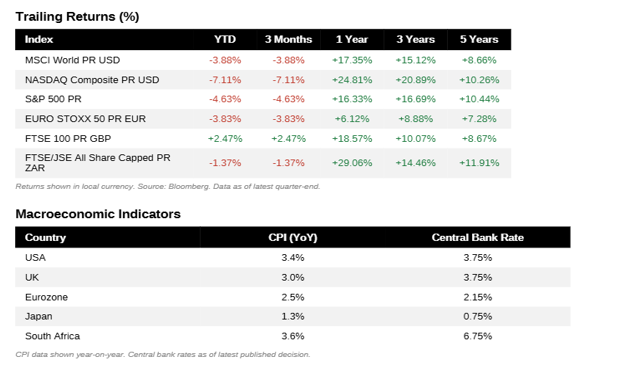
The first quarter of 2026 proved to be a volatile and eventful period for global financial markets, dominated by a sharp escalation in geopolitical tensions and a significant energy shock. The closure of the Strait of Hormuz following conflict in the Middle East triggered the largest disruption in global oil supply on record, sending oil prices above USD 100 per barrel and reshaping the macroeconomic landscape. As a result, inflation concerns resurfaced, bond yields moved higher, and global equity markets came under pressure. The MSCI World Index declined by 3.88% (USD) for the quarter, while commodities were a standout performer, The Bloomberg Commodity Index rose 24.4% (USD) during the quarter, with the gains driven overwhelmingly by the sharp increase in oil and gas prices, while precious metals such as gold and silver detracted from overall performance. Beneath the surface, however, there was notable rotation across sectors and regions, highlighting both risks and emerging opportunities for investors.
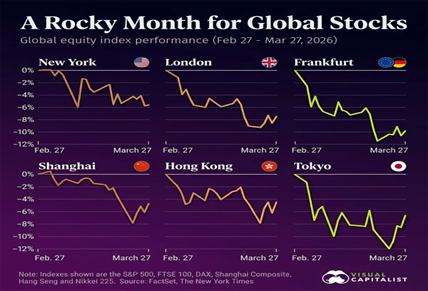
The below chart highlights the extent of the recent market sell-off, with major global indices across the US, Europe, and Asia all declining over the same period. This broad-based weakness reinforces that the current environment has been driven by a global macro shock, rather than region-specific factors. In periods like this, correlations between markets tend to rise, meaning there are fewer opportunities to rotate between regions to avoid volatility.
While uncomfortable, this type of synchronised decline is not unusual during times of heightened uncertainty. Importantly, it also creates opportunity. As markets reprice and valuations become more attractive across multiple regions simultaneously, the long-term return potential improves. From an investment perspective, this reinforces the importance of remaining invested and disciplined, rather than attempting to time short-term market movements.
United States
US markets faced a challenging quarter, with the S&P 500 declining 4.63% (USD) as rising bond yields, geopolitical uncertainty, and slowing growth expectations weighed on investor sentiment. Major indices ended the quarter in negative territory, with the Nasdaq declining 7.1% (USD) and the Dow Jones falling 3.6% (USD), reflecting weakness across both growth and cyclical sectors.
Technology stocks, which had led markets in recent years, came under pressure as investors reassessed the sustainability of AI-driven earnings and the scale of capital expenditure required to support future growth. While the Nasdaq underperformed over the quarter, it showed relative resilience during periods of heightened volatility as investors rotated towards higher-quality companies.
In fixed income markets, US Treasury yields moved higher over the quarter, with the 10-year yield rising to approximately 4.3% (USD), as markets repriced expectations for interest rates. While inflation risks remain elevated, the US economy is relatively better positioned compared to other regions due to its status as a net energy exporter.
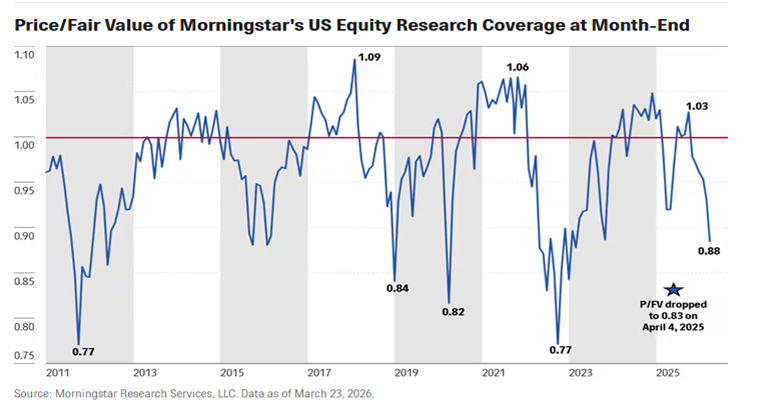
Despite this weakness, valuations have become more attractive. The US equity market is currently trading at an estimated 12% (USD) discount to fair value, with small-cap stocks offering even deeper value at a 17% (USD) discount. Growth stocks, which have been hardest hit, are now trading at a 21% (USD) discount, levels rarely seen over the past decade.
The chart below shows where the US market is currently trading relative to its fair value. Historically, similar valuation levels have presented attractive entry points, with markets typically delivering positive returns from these levels.
United Kingdom
The UK market delivered a relatively resilient performance, with the FTSE All-Share rising 2.47% (GBP) over the quarter. The market benefited from its strong exposure to commodity and energy companies, which performed well amid rising oil and gas prices. A weaker sterling also provided additional support to export-oriented businesses.
However, the UK economy remains particularly vulnerable to higher energy costs due to its reliance on natural gas. This has led to renewed inflation concerns and a more hawkish stance from the Bank of England. UK government bonds were among the weakest performers globally, declining -2.0% (GBP) as markets shifted from expecting rate cuts to pricing in potential rate hikes.
Europe
Europe’s equity markets faced significant headwinds in the first quarter of 2026, driven by renewed energy vulnerabilities and elevated geopolitical tensions. The Euro Stoxx 50 Index declined 3.83% (EUR) over the quarter, marking its first quarterly loss after eight consecutive advances. France’s CAC 40 fell 4.1% (EUR), while Germany’s DAX dropped 7.4% (EUR), reflecting broad-based selling pressure across the continent.
Inflation in the eurozone surprised markets by rising to 1.9% in February, up from 1.7% in January, reinforcing concerns about the region’s growth outlook. The MSCI Europe ex-UK Index also fell 2.3% (EUR), as elevated energy costs and geopolitical uncertainty weighed on investor sentiment. European gas prices, while not reaching the extremes of 2022, contributed to persistent worries about economic resilience. Overall, the European equity landscape reflected the challenges of energy dependence and geopolitical risk.
Emerging Market
Emerging markets demonstrated resilience for much of the quarter but ultimately ended marginally lower, with the MSCI Emerging Markets Index declining -0.1% (USD). While EM equities outperformed developed markets overall, they experienced significant volatility, particularly in March when risk sentiment deteriorated sharply.
The region remains highly sensitive to energy prices, with more than 80% of oil and gas flowing through the Strait of Hormuz destined for Asian economies. As a result, higher oil prices present a meaningful headwind to growth and inflation across many emerging markets.
Additionally, a stronger US dollar and rising US yields placed further pressure on EM assets, contributing to capital outflows and weaker currency performance across several regions.
Asia
Asian markets were negatively impacted by the surge in energy prices, given the region’s heavy reliance on imported oil and gas. The MSCI Asia ex-Japan Index declined -1.1% (USD) during the quarter, with performance deteriorating as the Middle East conflict intensified.
Japan stood out as a relative outperformer, with the TOPIX Index gaining 3.6% (JPY), supported by a weaker yen and expectations of continued fiscal stimulus following the ruling party’s election victory. Export-oriented sectors particularly benefited from currency weakness, helping offset broader global headwinds.
Across the region, earlier optimism driven by artificial intelligence demand supported technology-heavy markets such as Taiwan and South Korea, but these gains were partially reversed as geopolitical risks escalated and energy concerns intensified.
South Africa
South African markets experienced a sharp reversal in March after a strong start to the year. The FTSE/JSE Capped All Share Index declined 10.5% (ZAR) in March. The sell-off was largely driven by a sharp decline in precious metal prices, with gold falling 12% (USD) and platinum declining 18% (USD) during the month. This led to significant losses in mining stocks, with gold miners down 18% (ZAR) and platinum miners falling 25% (ZAR). Financials also came under pressure, with banks declining 10% (ZAR). In contrast, energy-linked companies were a bright spot, benefiting from higher oil and coal prices. Companies such as Sasol and local coal producers delivered strong gains during the period.
The South African rand weakened by 5.9% (ZAR) against the US dollar in March, reflecting global risk aversion and capital flows to safe-haven assets. The South African Reserve Bank maintained its policy rate at 6.75% (ZAR), with future policy decisions likely to be influenced by the persistence of inflationary pressures.
Gold
One of the more notable developments during the quarter was the sharp reversal in gold prices. Gold entered 2026 with strong momentum, extending its rally from 2025 and gaining approximately 25% (USD) in January, with prices rising above USD 5,300. The rally was supported by geopolitical uncertainty, strong central bank demand, and concerns around rising fiscal deficits in major economies.
However, this strength proved short-lived. Towards the end of January, gold prices fell more than -13% (USD) in a matter of days, with silver experiencing an even sharper decline. The sell-off was largely attributed to speculative positioning unwinding after an extended rally.
Following a period of stabilisation in February, gold declined again during March despite heightened geopolitical risk. Traditionally viewed as a safe-haven asset, gold instead reacted negatively to rising bond yields and shifting expectations around global monetary policy. Markets began pricing in the possibility of interest rate hikes from major central banks, increasing the opportunity cost of holding non-yielding assets such as gold.
The result was a highly volatile quarter for precious metals, challenging the conventional narrative of gold as a consistent hedge during periods of uncertainty.

Conclusion and House View
While the first quarter has been marked by volatility, it is important to remember that much of the market movement has been driven by short-term news, both positive and negative, rather than underlying economic fundamentals. Companies continue to grow, earnings remain solid, and the global economy is still in a healthy position despite headline risks.
Periods like this, though unsettling, present opportunities. The recent sell-off has pushed valuations down to levels that are attractive from a long-term perspective. By selectively increasing our exposure at these reduced prices, we can position ourselves to benefit from the eventual market recovery.
Markets are inherently unpredictable in the short term; nobody can determine exactly what will happen tomorrow. Over the long term, however, equity markets tend to focus on earnings growth and the performance of businesses rather than the daily noise. Staying invested, disciplined, and focused on high-quality companies is the best strategy to navigate volatility while capturing the growth potential that underpins markets over time.
As always, we will continue to monitor the macroeconomic and market environment to ensure our clients are positioned optimally to mitigate risks and take advantage of opportunities going forward. We remain committed to selectively increasing our equity exposure during periods of market weakness, a strategy designed to benefit our clients and enhance long-term portfolio performance.